Cotopaxi: Ecuador's Majestic and Mysterious Andean Giant
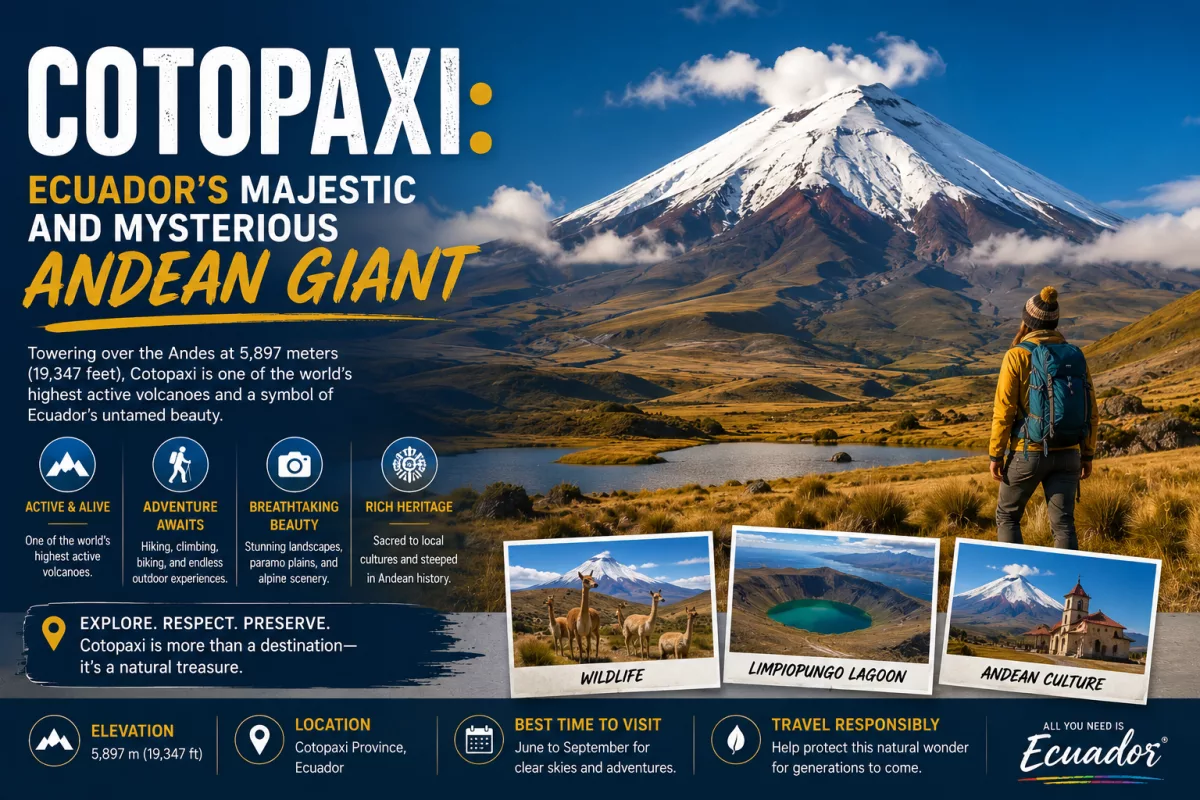
Do you know that there are certain sites on Earth that catch your attention right away? These places do this with their aura and a kind of mystery surrounding them. For me, such a place was Cotopaxi – the stratovolcano. It towers magnificently in the Ecuadorian Andes and can be considered not only a mountain but a whole phenomenon of nature with a history of its own and an effect on the environment around it.
Location of Cotopaxi in The Heart of The Andes
Well, where is the mountain located then? Cotopaxi is a stratovolcano located in the central part of the Andes range, about 50 kilometers (31 miles) to the south of Quito, the capital of Ecuador. As soon as you get the sight of this mountain, it will be impossible to mistake it. The perfect conical form with a bright ice cap makes this volcano stand out from any other peak like a sore thumb, making its appearance very dreamlike or even pictorial.
This is no ordinary mountain since it is the second highest peak in Ecuador with its elevation of 5,897 meters (19,347 feet). Can you imagine? The altitude of Cotopaxi is impressive itself, but it is what makes the mountain so impressive. The park that surrounds the volcano is the national park called Parque Nacional Cotopaxi, which is an amazing páramo (high-elevation grassland) and volcanic environment.
Cotopaxi's Fiery Past: Learning about Its Volcanic Temper
But now, how about its temper? Well, Cotopaxi is far from being just a dormant volcano. In fact, it is among the most active ones on the planet. Its native Kichwa name 'Cotocaxyi' stands for 'Neck of the Moon,' yet it definitely has more fire in its soul than a lunar one. Since 1738, it has already experienced more than 50 eruptions, some of which have been extremely catastrophic.
Can you imagine huge lahars, volcanic mudflows caused by the fast melting of glaciers on the mountain during an eruption, destroying everything on their way down the slopes of the volcano and reaching as far as the Pacific Ocean? The last time such a series of eruptions occurred was between 2015 and 2016, showing once again that Cotopaxi is still just sleeping and not dormant. Nowadays, the mountain is under close observation due to the great danger it represents for the local population. Scientists use various technical means to track the smallest movements and signs of its awakening.
Historic Eruptions: There have been major eruptions in 1742, 1768, and 1877 which were very destructive.
Ice Cap: This implies that any major eruptions will result in dangerous lahars.
Monitoring: Monitoring of the volcano by Instituto Geofísico on a continuous basis is absolutely crucial for the protection of people's lives.
High Altitude Ecosystems: Life around the Volcano
Though a highly unpredictable volcano, life around Cotopaxi thrives in abundance. The national park hosts a variety of high-Andean ecosystems. On your climb, you will find yourself in open páramo areas dominated by bunchgrasses and cushion plants, followed by small valleys. What I marvel about is the resilience of life amidst these harsh conditions.
Wild horse herds, Andean foxes, and various types of hummingbirds could be found in this habitat among the tough plants. Bird watching here is indeed impressive; I have come across some of the amazing birds here myself. If you are extremely lucky, you might even get to see the magnificent sight of Andean condor soaring overhead. Glacial meltwaters form clear streams and host various aquatic species of unique ecosystems.
Culture of the Mountain: Mythology and Indigenous Origin of Cotopaxi
This particular mountain is not just another mountain from the geographical point of view; it's also a cultural icon of the region of Ecuador. For a long time already, Cotopaxi was considered a sacred mountain that is known as Taita – father. This mountain was considered a god, and there were many legends related to its origin. It is an important part of the local culture because it was worshipped by the indigenous community for hundreds of years. People have lots of beliefs about this mountain, and its eruptions were always considered something very meaningful – either a manifestation of anger or happiness. It's a really interesting thing to know about, and it shows how people's lives are related to the surrounding nature.
The Charm of the Summit: Climbing and Adventures
Of course, there are people for whom Cotopaxi represents much more than an ordinary view. For experienced mountaineers from around the globe, climbing Cotopaxi is one of the main attractions in Ecuador. But you must keep in mind that climbing Cotopaxi implies climbing a real high mountain with high requirements both in terms of physical fitness and appropriate acclimatization. The climate may become unpredictable within minutes, and glaciers are fraught with their own dangers including crevices.
Most climbers begin their adventure at the José Rivas Refuge usually late at night in order to ascend to the summit before sunrise. There are also chances to have some wonderful views. However, such opportunity depends on whether there are no clouds or not. Many of my friends who climbed Cotopaxi once told me how fantastic was to stand on its top, looking at the surrounding world and feeling the strength of this volcano. Climbing Cotopaxi is a great achievement that demands enormous respect towards the mountain. It should be done only with guides.
Preservation efforts: Safeguarding a National Gem
Given its ecological, cultural, and scientific significance, protection of Cotopaxi and its park is one of the key priorities. The Parque Nacional Cotopaxi is designed to preserve the natural resources, the animals, and, most importantly, the volcano itself. The strategy to ensure proper preservation includes tourism management, educational programs aimed at raising awareness about conservation, and scientific research. There are constant projects aimed at monitoring the state of the glaciers which, unfortunately, are in retreat because of the changes in the global climate – a clear example of how global challenges even affect those giant glaciers in the mountains.
In conclusion, Cotopaxi isn’t just a mountain; it’s an experience. Cotopaxi is one of those places that makes you feel both inspired and challenged by the sheer wonder and magnificence of nature. Even from far away with just its perfect conical shape, Cotopaxi is one of the most awe-inspiring sites you can hope to see. Cotopaxi is an example of the greatness of Ecuador and nature. I believe that every individual should take time to visit Cotopaxi once in their lifetime since it is indeed amazing.
About Editorial Team
Senior columnist and culture critic specializing in architectural designs, emerging high-growth systems, and contemporary philosophies.